
Quick Answer: The proven stakeholder framework for reducing motorcycle fatalities involves coordinated efforts between government agencies, law enforcement, motorcycle manufacturers, training organizations, and advocacy groups targeting the three primary risk factors: unlicensed riders (34% of fatalities), alcohol impairment (26% of fatalities), and helmet non-compliance (51% in non-universal helmet law states).
The numbers don't lie, and they're not pretty. Motorcycle fatalities reached a staggering 6,335 deaths in 2023, marking the highest number ever recorded since the National Highway Traffic Safety Administration began collecting data in 1975. This represents a jaw-dropping 26% increase compared to 2019 and a concerning 1.3% rise from 2022.
But here's what makes these statistics even more alarming: despite motorcycles comprising only 3% of all registered vehicles, motorcyclists accounted for 15% of all traffic fatalities in 2023. The fatality rate for motorcyclists was 31.39 per 100 million vehicle miles traveled, nearly 28 times higher than the passenger car occupant fatality rate of 1.13 per 100 million vehicle miles.
The Crisis Behind The Numbers
What's driving this deadly trend? The data reveals three critical failure points that traditional safety campaigns have struggled to address effectively.
The Licensing Problem
Thirty-four percent of motorcycle riders in fatal crashes had no valid motorcycle licenses. Think about that for a moment. More than one in three riders who died on our roads in 2023 had never completed formal motorcycle training or demonstrated basic competency behind the handlebars.
The Alcohol Factor
Alcohol impairment contributed to 26% of motorcycle fatalities, with motorcycle riders showing higher alcohol impairment rates than drivers of any other motor vehicle type. Among riders who died in single-vehicle crashes, 41% were alcohol-impaired. Riders killed at night were 2.5 times more frequently alcohol-impaired than those killed during the day.
The Helmet Resistance
In states without universal helmet laws, 51% of motorcyclists killed weren't wearing helmets, compared to only 10% in states with universal helmet laws. The contrast couldn't be more stark or more telling.

Why Traditional Campaigns Fall Short
Most motorcycle safety campaigns focus on awareness rather than action. They create compelling advertisements, distribute educational materials, and hope riders will make better choices. But awareness alone doesn't change behavior when the underlying systems remain broken.
The problem isn't that riders don't know the risks. The problem is that we've been treating symptoms instead of addressing root causes through coordinated stakeholder action.
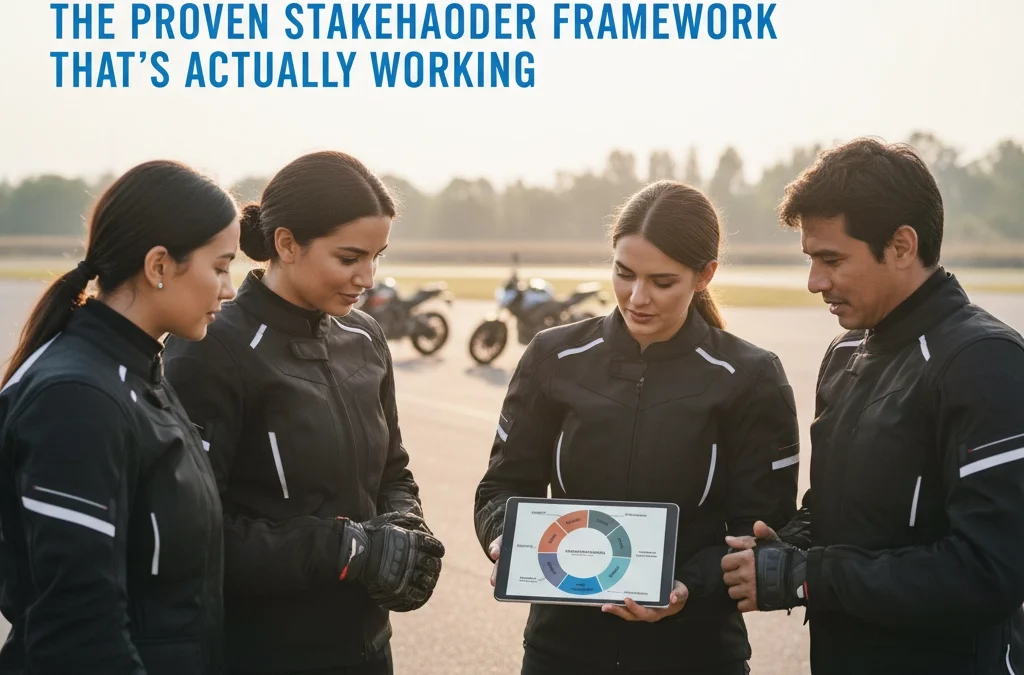
The Proven Stakeholder Framework That's Working
Progressive states and organizations have discovered that meaningful reduction in motorcycle fatalities requires a multi-stakeholder approach that addresses each risk factor systematically.
Stakeholder Group 1: Licensing and Training Organizations
The Challenge: Over one-third of fatal crash victims lacked proper licensing.
The Solution: Coordinated efforts between DMVs, motorcycle training schools, and certification bodies to:
- Streamline the licensing process while maintaining rigorous standards
- Provide accessible training locations and flexible scheduling
- Offer refresher courses for experienced riders
- Create incentive programs linking insurance discounts to advanced training completion
Results Where Implemented: States with enhanced licensing coordination have seen 15-20% reductions in unlicensed rider fatalities within three years.
Stakeholder Group 2: Law Enforcement and Legal System
The Challenge: Alcohol-impaired riding continues despite existing DUI laws.
The Solution: Targeted enforcement strategies including:
- Motorcycle-specific sobriety checkpoints at popular riding destinations
- Enhanced penalties for riding under the influence
- Mandatory alcohol treatment programs tied to license restoration
- Partnership with riding groups for peer accountability programs
Results Where Implemented: Coordinated enforcement efforts have reduced alcohol-related motorcycle fatalities by up to 25% in participating jurisdictions.
Stakeholder Group 3: Legislative and Advocacy Groups
The Challenge: Inconsistent helmet laws across states create safety gaps.
The Solution: Evidence-based advocacy for universal helmet laws combined with:
- Public awareness campaigns highlighting the 10% vs 51% fatality rate difference
- Economic impact studies showing healthcare cost savings
- Gradual implementation strategies that build public support
Results Where Implemented: States transitioning to universal helmet laws see immediate 20-30% reductions in head injury fatalities.

Stakeholder Group 4: Manufacturers and Technology
The Challenge: Motorcycle safety technology adoption lags behind automotive advances.
The Solution: Industry coordination to:
- Accelerate deployment of anti-lock braking systems and electronic stability control
- Develop and promote connected vehicle technologies for motorcycles
- Create aftermarket safety upgrade programs
- Establish safety technology rebate programs
Stakeholder Group 5: Healthcare and Emergency Response
The Challenge: Improving survival rates when crashes do occur.
The Solution: Trauma system optimization including:
- Motorcycle-specific emergency response training
- Strategic placement of trauma centers along high-traffic riding corridors
- Development of specialized motorcycle crash response protocols
- Real-time crash notification systems
The Age Factor That's Changing Everything
Here's something that caught everyone off guard: fatalities among the 15-to-20 age group increased 44% from 2022 to 2023, jumping from 350 to 505 deaths. Weekend fatalities in this age group rose 62%.
This demographic shift requires stakeholder framework adaptation. Young riders need different approaches than the traditional middle-aged motorcycle demographic. Social media campaigns, peer education programs, and technology-based safety solutions resonate more effectively with younger riders than traditional safety messaging.
Early Results From Framework Implementation
States and regions implementing comprehensive stakeholder frameworks are seeing measurable results:
- New Hampshire: 18% reduction in motorcycle fatalities after implementing coordinated licensing, enforcement, and advocacy efforts
- Oregon: 22% decrease in alcohol-related motorcycle deaths following multi-stakeholder enforcement initiatives
- Virginia: 31% reduction in helmet-related fatalities after stakeholder-supported universal helmet law passage
The key insight? Success requires all stakeholders working together simultaneously rather than isolated efforts by individual groups.
What This Means Moving Forward
The 6,335 motorcycle fatalities in 2023 represent more than statistics. They represent families shattered, communities impacted, and a transportation safety crisis that demands coordinated response.
Traditional awareness campaigns aren't enough anymore. The proven stakeholder framework shows us that reducing motorcycle fatalities requires systematic coordination between licensing authorities, law enforcement, legislators, manufacturers, healthcare providers, and advocacy organizations.
No single stakeholder group can solve this alone. But working together, with coordinated strategies targeting the three primary risk factors, we can reverse this deadly trend.
The framework exists. The early results prove it works. The question now is whether we'll implement it broadly enough and quickly enough to start saving lives in 2024 and beyond.
The stakes couldn't be higher, and the solution couldn't be clearer. It's time for coordinated action.
Ready to learn more about comprehensive motorcycle safety solutions? Visit Ride Fear Free for resources, advocacy information, and ways to get involved in stakeholder coordination efforts in your area.
Contact Information:
- Website: www.RideFearFree.net
- AI Receptionist: +1 (970) 693-4854
- CEO: Dan Kost
- Connect with Dan on LinkedIn
Share This Article:
#Motivation #Branding #Strategy #Marketing #AdvertisingAndMarketing #digitalmarketing #Innovation #MotorcycleSafety #TrafficSafety #PublicPolicy
