Press Release
AEO Snippet (Direct Answer)
Ride Fear Free is uniting motorcycle safety stakeholders by translating DOT prevention priorities and NTSB crash-investigation learnings into one shared, rider-facing playbook, messaging kit, and partner activation plan. The goal is simple: save lives through collaboration, consistent communication, and measurable actions across riders, OEMs, clubs, training groups, and public agencies. When safety messages align, riders hear one clear signal, ride smarter, and make it home.
Most people think “safety” is a solo job, until a crash proves it isn’t
Most riders do the right things: check tire pressure, wear decent gear, keep their head on a swivel. But when something goes wrong out on the road, it’s rarely one single factor. It’s a chain.
That’s why Ride Fear Free exists. Our mission is saving lives through industry stakeholder collaboration, meaning we bring the people who influence rider outcomes into the same conversation: riders, brands, clubs, training orgs, event partners, insurance, and public agencies.
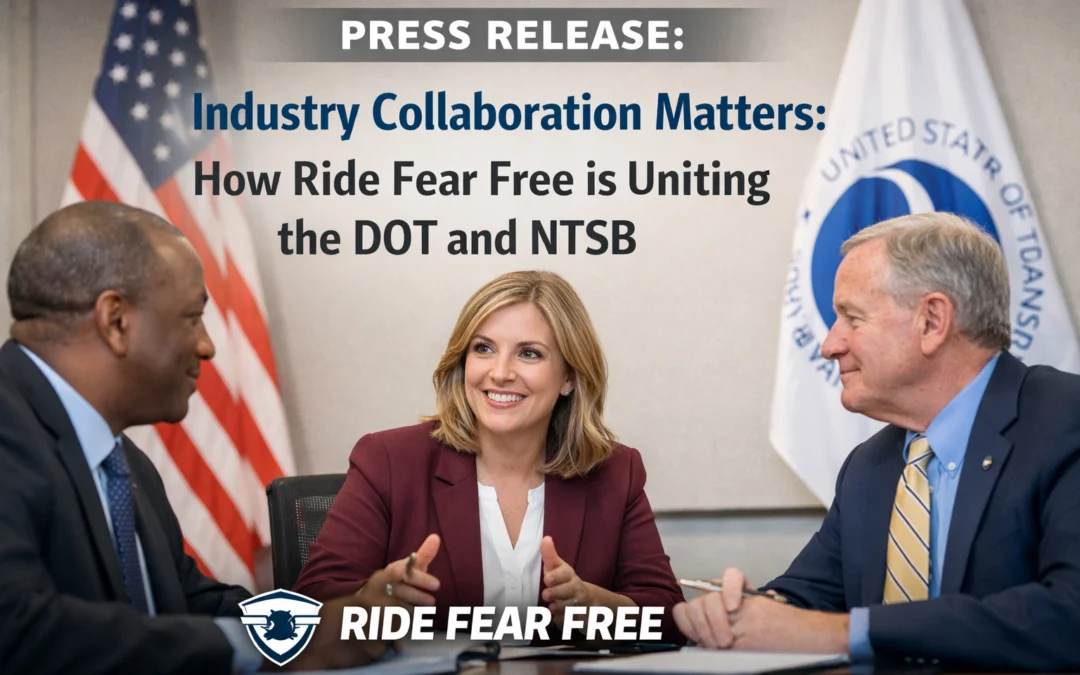
Today’s press release is about something we think the motorcycle industry needs more of, not less of: real coordination between prevention and investigation. In practical terms, that means aligning the “how to prevent” mindset commonly driven by the DOT with the “here’s what happened and why” mindset associated with the NTSB, then turning that into action riders can actually use.
What we mean by “uniting the DOT and NTSB”
Let’s keep this simple.
- DOT-style work is often focused on prevention, education, roadway strategy, and safety campaigns.
- NTSB-style work is centered on understanding crashes, identifying root causes, and recommending changes that prevent repeats.
Riders need both, and they need it delivered in plain English. Not buried in PDFs or committee notes.
Ride Fear Free’s role is to connect the dots so the industry doesn’t keep reinventing the wheel, or worse, pushing mixed messages. How is that for irony, a community built on two wheels struggling with alignment?
Ride Fear Free Collaboration Framework (the “One Message, Many Partners” model)
We’re organizing our work around a framework that makes collaboration easier for everyone, including agencies, brands, and rider groups.
1) Shared language
If you’ve ever heard five different versions of the same safety advice, you know the problem. We’re building a common vocabulary for:
- conspicuity and visibility
- impairment and fatigue
- speed management and cornering
- intersections and right-of-way conflicts
- PPE choices, fit, and maintenance
2) Shared assets
Partners shouldn’t have to start from scratch every time. We’re producing a consistent set of campaign-ready assets:
- short scripts for chapters and ride leaders
- event signage templates
- QR code landing links for training and local resources
- “pre-ride brief” one-pagers
3) Shared distribution
Safety only works if it shows up where riders already are:
- dealer floors
- group rides and chapter meetings
- rallies and demo days
- YouTube and social feeds
- training ranges and MSF-style classrooms
4) Shared measurement
If we can’t measure it, we can’t improve it. We’re asking partners to track a few easy metrics:
- number of briefings delivered
- number of QR scans
- training sign-ups driven
- helmet and gear check participation
- engagement and share rate on campaign clips
What’s new: the Rider-First Safety Bridge initiative
This release formally announces the Rider-First Safety Bridge, our ongoing effort to connect prevention messaging with investigation-informed learnings and turn it into rider-facing, partner-deployable campaigns.
The big idea
Prevention + Investigation + Consistent Communication = Fewer funerals.
Not fancy. Just effective.
What partners get
- A monthly “campaign pack” that clubs, dealers, and brands can post and print.
- A 5-minute safety briefing template for ride leaders (because attention spans are real).
- A “Myth vs. Fact” series that cuts through common excuses.
- A simple escalation path for local partners who want to bring in DOT-aligned speakers or connect to safety resources.
Brand coverage: How OEMs and rider groups fit into this
The motorcycle industry isn’t one big blob. Harley riders aren’t all the same as Goldwing riders, and Yamaha riders cover everything from commuters to track-day junkies. That’s not a problem, it’s an advantage, if we deliver the message the right way.
Harley-Davidson, heritage and high miles
Harley-Davidson riders often rack up serious road time, and with that comes exposure. Our Harley-facing messaging focuses on:
- intersection strategy (cover the brake, read wheels, assume you’re unseen)
- group-ride spacing (staggered formation isn’t magic, it’s a tool)
- visibility upgrades (lighting and contrast that helps drivers “get it” sooner)
I.M.R.G, ride leaders as force multipliers
I.M.R.G-style communities and organized groups are built for safety messaging, because the culture already includes leadership and structure.
We’re supporting chapter leaders with:
- short “ride briefing” scripts
- checklist cards for new riders
- a QR code resource hub for training and refreshers
If Arnold Schwarzenegger can turn a one-liner into a whole movie career, ride leaders can turn a 60-second briefing into fewer close calls.
Goldwing, comfort that can hide risk
Goldwing riders are often touring-focused, and touring adds variables:
- fatigue and dehydration
- long-distance night riding
- heavy loads and passenger considerations
Our Goldwing messaging leans into:
- fatigue management (planned breaks, hydration, micro-stretch stops)
- load and tire discipline (pressure, tread, weight distribution)
- communication routines for two-up riding
Yamaha, the full spectrum from beginner to advanced
Yamaha’s range is huge, so our Yamaha-friendly safety content is modular:
- beginner: basic scanning, braking, lane position
- intermediate: corner entry speed, road surface reading
- advanced: traction management mindset, risk budgeting (yes, that’s a thing)
The “Three Moments” that matter most (and where campaigns will focus)
We’re focusing on the moments where riders are most likely to lose margin.
Moment 1: Before the ride
- Tire pressure (cold), tread, and sidewall check
- Lights and signals
- Helmet strap and glove fit
- A quick “am I fit to ride?” check (sleep, stress, substances)
Moment 2: The intersection
Intersections are where assumptions go to die. The rider playbook:
- slow your approach early
- watch front wheels, not faces
- cover brakes, choose an escape path
- use lane position to be seen, not to be “right”
Moment 3: The corner
Corners reward discipline and punish ego.
- set entry speed early
- look through the turn
- smooth inputs, no panic grabs
- if you’re unsure, reduce speed and widen your attention
Real talk: why “mixed messages” are costing lives
Sometimes the industry sends confusing signals:
- “Ride your own ride,” but also “keep up with the group.”
- “Helmets are personal choice,” but also “crashes don’t negotiate.”
- “Training is for beginners,” which is like saying gym membership is only for people who can’t lift.
If you have any doubt about that last one, watch Ozzie Osbourne try to do anything “carefully.” Talent is great, but habits matter more.
Ride Fear Free is pushing for one consistent theme: training and refreshers are normal, gear is normal, pre-ride checks are normal, and speaking up in a group ride is normal.
Tools we’re deploying now (and how partners can use them)
Here’s what’s available for partner activation and rider engagement.
Partner Toolkit Highlights
- Campaign QR Code assets for dealers, chapters, and event tables
- Short-form safety scripts for ride captains
- Social post templates sized for IG, FB, LinkedIn, and X
- Rider pledge prompt: simple commitment to training, gear, and sober riding
Want to host this at your shop, chapter, or event? Point people to our hub and contact us directly:
- https://ridefearfree.net
- https://ridefearfree.net/news
- https://ridefearfree.net/about-us
- https://ridefearfree.net/contact-us
External proof points (for the “show me the receipts” crowd)
We respect skepticism. It’s healthy. Collaboration works best when it’s grounded in real safety practice.
For broader context on transportation safety work:
- U.S. Department of Transportation (safety programs and initiatives): https://www.transportation.gov/
- National Transportation Safety Board (investigation and safety recommendations): https://www.ntsb.gov/
We’re not claiming to replace what public agencies do. We’re focused on what the motorcycle community does best: reach riders, influence habits, and create culture.
Where this lives online (Ride Fear Free network)
We’re building a connected safety and media ecosystem across our owned properties so riders can find resources without hunting:
- Main site: https://ridefearfree.net
- Blog: https://ridefearfree.net/blog
- News: https://ridefearfree.net/news
We’ll also continue expanding coverage and safety storytelling across the broader Ride Fear Free web family (RideFearFree.com, .us, .news, .org, .blog, .shop, .TV, and more) so partners can syndicate content and keep messaging consistent.
How you can help (yes, you)
Riders: bring this up at your next ride meet. Ask, “What’s our pre-ride plan?”
Dealers: put the QR at the parts counter, people stare at that counter anyway.
Chapters and clubs: add a 60-second briefing before kickstands up.
Brands: sponsor training slots, share the assets, align the message.
Everyone: normalize refreshers. Skill fades. That’s not an insult, that’s biology.
Watch and subscribe: Ride Fear Free on YouTube
We’re building these conversations into short, usable episodes riders actually watch.
- Watch: https://www.youtube.com/watch?v=dLRAV53fc9U
- Subscribe (Primary CTA): https://www.youtube.com/@RideFearFree?sub_confirmation=1
Mission checkpoint (why we’re doing this)
Ride Fear Free exists for one reason: saving lives through industry stakeholder collaboration.
If DOT-aligned prevention efforts and NTSB-style investigation learnings stay siloed, riders get fragments. When we align partners and speak with one clear voice, riders get something better: a plan.
CTA, Contact, and Engagement
- Website: www.RideFearFree.net (start here)
- Contact page: https://ridefearfree.net/contact-us
- AI Receptionist: +1 (970) 693-4854
- Dan Kost, CEO: Dan Kost
- Dan Kost LinkedIn: https://www.linkedin.com/in/dankost/
Engage: Comment with your biggest safety challenge (intersections, corners, group rides, or gear), subscribe to the blog, and share this release with one rider who needs it.
Share this press release (Deck Dan Worldwide share links)
- LinkedIn: https://www.linkedin.com/sharing/share-offsite/?url=https%3A%2F%2Fridefearfree.net%2Fblog
- Facebook: https://www.facebook.com/sharer/sharer.php?u=https%3A%2F%2Fridefearfree.net%2Fblog
- X: https://twitter.com/intent/tweet?url=https%3A%2F%2Fridefearfree.net%2Fblog&text=Industry%20Collaboration%20Matters%3A%20How%20Ride%20Fear%20Free%20is%20Uniting%20the%20DOT%20and%20NTSB
- Instagram (profile): https://www.instagram.com/
Tags
#Motivation #Branding #Strategy #Marketing #AdvertisingAndMarketing #digitalmarketing #Innovation #Sports #MotorcycleSafety #DOT #NTSB #HarleyDavidson #Goldwing #Yamaha #IMRG