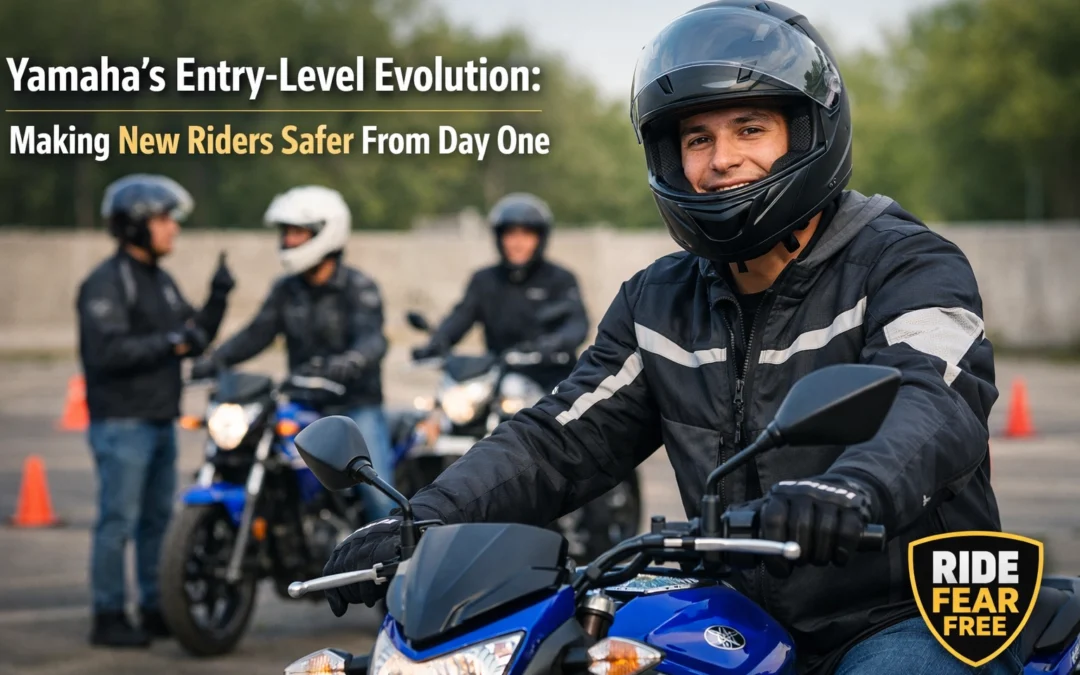
Most people think starting on a motorcycle is a dangerous gamble, until they see how Yamaha is rewriting the rules of rider safety for beginners.
How is Yamaha making entry-level riding safer?
Yamaha makes entry-level riding safer by integrating advanced rider aids once reserved for high-end sportbikes, and by pushing crash-protection tech into everyday machines. Through features like Anti-lock Braking Systems (ABS), Traction Control (TCS), and the Yamaha Chip Controlled Throttle (YCC-T), new riders gain a protective digital layer. And now, Yamaha is even spotlighting scooter safety tech, like the Tricity 300’s built-in airbag concept, to show that practical commuting and serious protection can live on the same platform.
The First Ride Fear
We have all been there. You are sitting on a machine that weighs hundreds of pounds, your heart is racing, and you are trying to remember where the clutch ends and the throttle begins. For decades, the advice for new riders was to buy an old, beat up bike and "learn the hard way." But at Ride Fear Free, LLC, we believe that the "hard way" is often the dangerous way.
Yamaha has taken a different path. They have looked at the data and realized that the more confidence a rider has, the safer they are. By evolving their entry-level lineup, they are not just selling motorcycles. They are selling a safer way to enter the community we love. If you want to see how this looks in action, check out our latest insights on the Ride Fear Free YouTube Channel.
Building a Foundation of Safety Architecture
When we talk about entry-level bikes like the WR125R or the MT-03, we are looking at machines designed with a layered safety strategy. It starts with the Core Safety Architecture. Yamaha has prioritized crash protection and digital assistance to create a foundation that protects riders without being overwhelming.
The Power of ABS and TCS
The foundational safety suite on modern Yamaha entry models includes:
- Anti-lock Braking System (ABS): This is a game changer for beginners. In a panic situation, a new rider’s instinct is to grab a handful of brake. On an old bike, that means a locked front wheel and a trip to the pavement. On a Yamaha equipped with Bosch hydraulic units, the system monitors wheel speed and prevents lockups, even in rain or on gravel.
- Traction Control System (TCS): This keeps the rear tire from spinning out under acceleration. For someone still learning throttle control, this digital safety net is the difference between a smooth takeoff and a scary slide.
- Back Slip Regulators: This system prevents the rear wheel from locking up during aggressive downshifts or sudden deceleration.

Advanced Rider Aids: The Brain Inside the Bike
You might think that things like a "six-axis Inertial Measurement Unit" (IMU) are only for professional racers. How is that for irony? The riders who need the most help are usually the ones who get the least amount of technology on their bikes. Yamaha is changing that.
By putting advanced sensors into entry-level models, the bike can monitor its own lean angle and movement in real-time. This data feeds into the Engine Control Unit (ECU) to enable:
- Cornering ABS: Standard ABS is great, but cornering ABS adjusts braking pressure based on how far the bike is leaned over. This helps keep the bike stable if you have to brake while turning.
- Wheelie Control: For new riders, an accidental "whiskey throttle" can lead to the front wheel lifting. This system keeps the rubber on the road.
- Engine Brake Management: This smooths out the feeling when you let off the gas, making the bike feel less "jerky" and more predictable.
Tech Highlight: Tricity 300 and the First-Ever Production Scooter Airbag
If you’ve ever thought scooters were "less serious" about safety, you’ll want to sit down for this. Yamaha’s Tricity 300 has been making headlines for introducing what multiple outlets are calling the first-ever airbag on a production scooter, developed with automotive safety supplier Autoliv. The airbag is integrated into the scooter’s front structure and is designed to deploy in certain frontal-impact scenarios, with the goal of reducing how violently a rider’s upper body meets the bars and hard points.
A few practical takeaways for riders and safety leaders:
- This is a big deal for everyday commuting. A lot of real-world crashes happen close to home at lower speeds, in traffic, at intersections.
- It normalizes crash protection outside of premium touring bikes. Airbags have been rare in the powersports world, so seeing the idea enter the scooter segment is a signal that the safety ceiling is rising.
- It also creates an education gap. If people do not understand what the airbag is designed to do, and what it is not designed to do, the feature gets misused in public conversation and misrepresented in the media.
External references for context: Cycle World coverage and Road and Track overview.
Mechanical Magic: YCC-T and UBS
While electronics get all the headlines, mechanical design plays a huge role in making a bike approachable. Yamaha's Entry-Level Evolution includes the Yamaha Chip Controlled Throttle (YCC-T).
Instead of a physical cable pulling the throttle open, your input is sent to a computer that manages the engine's response. This means if a new rider is a bit too twitchy with their hand, the computer smooths out the power delivery. It prevents the sudden jolts that often intimidate people who are just starting out.
Then there is the Unified Braking System (UBS). This is an understated feature that intelligently links the front and rear brakes. When you apply the rear brake, the system provides a bit of front brake pressure as well. This results in much smoother, more balanced stops. It is perfect for real-world conditions where you might encounter unexpected patches of sand or wet leaves.
Visibility and Ergonomics
Safety is not just about what happens when things go wrong. It is about making sure you are seen and comfortable enough to stay focused. Yamaha has integrated standard full LED lighting across their lineup. This is critical for urban safety, especially during dawn, dusk, or night rides.
Ergonomics also play a vital role. If a rider is struggling to reach the ground or feels cramped, they are not focusing on the road. Yamaha’s entry-level models often feature adjustable seating and clear, intuitive digital instrumentation. If you can read your speed and gear position at a glance, you can keep your eyes where they belong: on the path ahead.
Smart Connectivity for Smart Riders
One of the most modern additions to the Yamaha lineup is the Yamaha Motorcycle Connect (Y-Connect) system. By linking your smartphone to your bike, you get access to:
- Ride Tracking: Analyze your routes and see where you can improve your riding smoothness.
- Real-time Diagnostics: The bike tells you if something is wrong before it becomes a safety hazard.
- Maintenance Alerts: Proper maintenance is a safety issue. Y-Connect ensures you never miss an oil change or a tire check.
At Ride Fear Free, LLC, we advocate for this kind of proactive approach. A well-maintained bike is a predictable bike, and predictability is the key to riding without fear. You can learn more about our mission and partnerships on our About Us page.
Why This Matters for the Industry
When Yamaha makes a safer entry-level bike, it forces the entire industry to level up. We see similar trends with I.M.R.G, Harley-Davidson, and Honda. Whether it is a Goldwing or a Yamaha R3, the focus is shifting toward rider longevity. We don't just want you to start riding. We want you to keep riding for the next fifty years.
If you are a new rider or looking to get back into the saddle, do not settle for outdated tech. Look for the innovations that Yamaha is bringing to the table. It is about more than just speed. It is about the freedom to explore without the constant shadow of unnecessary risk.

Join the Movement
The evolution of motorcycle safety is a journey we are all on together. Whether you are cruising through Alaska or navigating city traffic, the goal remains the same: Ride Fear Free.
Bridging high-tech safety and public awareness, that is where Ride Fear Free, LLC operates best. It is one thing for Yamaha (or any OEM) to ship advanced safety tech like ABS, traction control, and now even airbag-equipped scooters. It is another thing entirely to make sure the public understands it, trusts it, and changes behavior because of it. Our advertising campaigns focus on closing that gap by:
- Translating complex safety tech into plain-English benefits that riders and drivers actually remember.
- Amplifying consistent, cross-industry messaging so safety features do not get lost in brand silos.
- Pairing "what the tech does" with "what you do next", training, gear, visibility, and smart riding choices.
Want more safety breakdowns and campaign insights? Subscribe here, it helps us grow the reach of the message:
https://www.youtube.com/@RideFearFree?sub_confirmation=1
We invite you to stay connected with us as we continue to track these industry changes and advocate for better safety standards across all brands.
- Subscribe to our YouTube Channel: Join the Ride Fear Free Community
- Follow us on LinkedIn: [Placeholder for LinkedIn Follow Button]
- Subscribe to our Newsletter: [Placeholder for LinkedIn Subscriber Button]
For more updates on the latest in motorcycle technology and safety initiatives, visit our News section.
Connect With Us
Ride Fear Free, LLC
Website: www.RideFearFree.net
AI Receptionist: +1 (970) 693-4854
Dan Kost, CEO
Connect with Dan Kost on LinkedIn
Share this post:
Share on LinkedIn | Share on Facebook | Share on X | Share on Instagram
#Motivation #Branding #Strategy #Marketing #AdvertisingAndMarketing #digitalmarketing #Innovation #Sports #MotorcycleSafety #Yamaha #NewRider #BikeTech #RideFearFree
