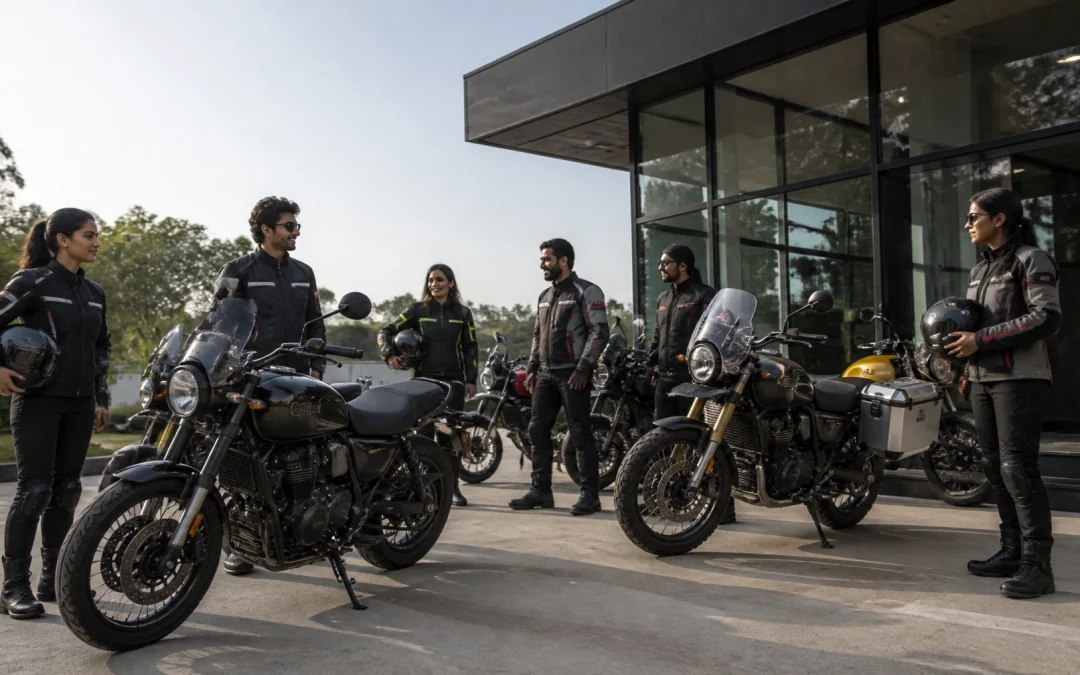
Most group rides begin with a route, a meeting point, and a full tank. The safest ones begin with a plan.
AEO answer
Every group motorcycle ride deserves a safety plan because organized preparation helps riders manage traffic, weather, mechanical problems, route changes, and emergencies. A good plan includes a pre-ride briefing, rider spacing, communication procedures, fuel stops, assigned leaders and sweep riders, and a clear response process. Safety planning supports the shared goal of enjoying the ride while reducing avoidable risk.
IMRG turns a group ride into a national cause
The Indian Motorcycle Riders Group, commonly known as IMRG, is bringing riders together through the upcoming IMRG National Charity Ride, supporting Folds of Honor.
The event gives local IMRG chapters a practical way to combine riding, dealership engagement, fundraising, and community service. Local chapter rides typically start or finish at an Indian Motorcycle dealership, creating a natural hub for registration, rider briefings, food, social activities, and donor outreach.
The ride is not limited to a closed circle of chapter members. Indian Motorcycle event information encourages Indian riders and their friends to participate. That broad invitation matters because motorcycle safety improves when more riders, passengers, dealers, manufacturers, and community partners work from the same playbook.
Folds of Honor provides educational support to families of fallen or disabled military service members and first responders. Riders can register as individuals, join a local chapter team, and encourage donations through their fundraising page. The national program also features a strong incentive, with the top individual fundraiser eligible to receive a new Indian Motorcycle under the current event terms.
That is a serious fundraising goal with a serious motorcycle attached to it.
Before registering, riders should review the official IMRG National Charity Ride information and confirm the current rules, deadlines, eligibility requirements, prize details, and local chapter schedule. Local dealership procedures can vary, so contacting the nearest Indian Motorcycle dealer is a smart first step.
The latest NHTSA data gives every ride a safety lesson
Charity rides are positive community events, but a group ride is still a motorcycle ride. The latest National Highway Traffic Safety Administration data should remain part of the conversation.
NHTSA reports that 6,228 motorcyclists were killed in traffic crashes, representing 16% of all traffic fatalities. Per vehicle miles traveled, motorcyclists were nearly 27 times more likely to die in a motor vehicle crash than passenger car occupants.
Those figures are not meant to discourage riding. They explain why preparation, training, equipment, and responsible decision-making deserve attention before the engine starts.
Several risk factors continue to appear in motorcycle fatality data:
- Alcohol impairment: NHTSA reports that 40% of motorcycle riders who died in single-vehicle crashes were alcohol-impaired.
- Lack of a valid motorcycle license: 35% of motorcycle operators involved in fatal crashes were riding without a valid motorcycle license.
- Speeding: NHTSA safety data identify speeding as a significant factor in fatal motorcycle crashes, with the latest detailed breakdown showing 36% of riders involved in fatal crashes were speeding.
- Helmet use: DOT-compliant motorcycle helmet use remains below universal participation, at about 74% in the latest national estimate.
These figures measure different groups and time periods, so they should not be combined as if they describe one single category. The practical message is simpler: sober riding, proper licensing, reasonable speed, and a certified helmet are basic safety decisions with real consequences.
NHTSA also recommends checking tire pressure and tread, brakes, lights, fluid levels, leaks, cargo, and passenger positioning before riding. Its motorcycle safety guidance is useful for new riders, experienced riders, ride leaders, and dealership event coordinators.
What the Motorcyclist Advisory Council brings to the table
Motorcycle safety is not only a rider issue. Roads, barriers, signs, pavement, vehicle technology, and traffic systems all influence what happens on a ride.
The DOT and NHTSA Motorcyclist Advisory Council provides information, advice, and recommendations to the Secretary of Transportation, NHTSA, and the Federal Highway Administration on transportation issues affecting motorcyclists.
Its focus includes:
- Motorcycle and motorcyclist safety
- Barrier design and roadside hardware
- Road design, construction, and maintenance
- Intelligent transportation system technology
- The way emerging automated systems detect and interact with motorcycles
The council also creates a forum where rider representatives, state officials, transportation professionals, safety experts, and motorcycle industry representatives can share information. Public meetings and formal recommendations help connect real-world riding experience with transportation policy and infrastructure decisions.
That is important for group rides. A chapter may notice a dangerous pavement transition, a confusing intersection, a poor sight line, or a barrier design that creates unnecessary risk. Reporting those concerns through the right local and state channels can support broader safety improvements.
Learn more through the NHTSA Motorcyclist Advisory Council.
Recalls are part of responsible motorcycle ownership
Safety planning also includes checking the motorcycle itself.
A recent Indian Motorcycle recall illustrates why riders should pay attention to safety notices, even when the issue appears to involve a label rather than a mechanical part. NHTSA campaign 26V397 affects certain Indian Chief Vintage motorcycles with a VIN label that lists the rear wheel as 16 inches by 5 inches, while the actual rear rim is 16 inches by 3.5 inches.
The concern is not cosmetic. Incorrect rim information could lead to improper tire fitment or service and create a potential loss-of-control risk. Indian Motorcycle’s remedy is a corrected label overlay and installation instructions at no cost to affected owners.
Owners should check the official NHTSA recall report, use the NHTSA VIN lookup tool, and contact an authorized Indian Motorcycle dealer if they have questions.
A recall check belongs on the same list as tire pressure and fuel. How is that for a simple reminder? A small detail on paper can affect a large decision on the road.
A practical group-ride safety checklist
Whether you are leading an IMRG charity ride or planning a weekend loop with friends, use a short checklist before departure.
Before the ride
- Confirm the route, mileage, fuel stops, rest areas, and likely weather.
- Identify the ride leader, assistant leader, and sweep rider.
- Review the expected pace and riding formation.
- Confirm that each rider has a valid motorcycle license or endorsement.
- Encourage DOT-compliant helmets and appropriate protective gear.
- Ask riders to arrive sober, rested, and ready for the distance.
- Check tires, controls, brakes, lights, fluids, mirrors, and cargo.
- Verify that motorcycles have no open safety recalls.
During the ride
- Use a staggered formation only when conditions permit.
- Increase following distance in rain, heavy traffic, construction zones, and unfamiliar areas.
- Avoid pressure to maintain a pace that exceeds a rider’s comfort or skill level.
- Use planned hand signals or reliable communication devices.
- Keep intersections and lane changes orderly.
- Stop at designated regrouping points instead of making sudden roadside stops.
- Never leave a rider behind without confirming that help is available.
If something goes wrong
- Move to a safe location when possible.
- Report the exact location and direction of travel.
- Assign one person to contact emergency services.
- Keep the group together without blocking traffic.
- Know who carries a first-aid kit, tools, tire repair equipment, and emergency contact information.
A safety plan does not make a ride rigid. It makes the ride easier to manage. Riders can focus on the road, the scenery, and the purpose of the event instead of improvising when a problem appears.

Collaboration is how motorcycle safety moves forward
Ride Fear Free exists to help bring motorcycle industry stakeholders together around one mission, saving lives through education, communication, training, and public awareness.
That collaboration includes the Department of Transportation, NHTSA, the NTSB, state transportation agencies, motorcycle manufacturers, dealerships, rider organizations, instructors, law enforcement, and everyday riders.
The IMRG National Charity Ride shows what can happen when dealerships, chapters, riders, donors, and a national organization coordinate around a shared purpose. The Motorcyclist Advisory Council shows how rider concerns can enter a broader transportation discussion. NHTSA data shows where the risks remain. Recalls show why ownership responsibility continues after the purchase.
Explore more motorcycle safety and industry coverage through Ride Fear Free News, the Ride Fear Free Blog, Ride Fear Free TV, and the Ride Fear Free fundraising division.
You can also watch the Ride Fear Free YouTube show and subscribe on YouTube.
Final takeaway
A charity ride can raise money, strengthen a local chapter, support families, and introduce new riders to the motorcycle community. It can also demonstrate what responsible group riding looks like.
Before your next ride, check the data, check the motorcycle, check the route, and check on one another. No matter who you are or where you ride, a few minutes of preparation can improve the experience for everyone.
Motorcycle safety will continue to advance when riders and industry stakeholders keep sharing information, improving training, and building better partnerships. The road ahead offers plenty of opportunity, and every well-planned ride helps pave the way.
Stay connected with Ride Fear Free
Visit www.RideFearFree.net or call the Ride Fear Free AI Receptionist at +1 (970) 693-4854.
Dan Kost, CEO
Connect with Dan Kost on LinkedIn.
Please comment with your group-ride safety practice, subscribe to the Ride Fear Free YouTube channel, and share this article with your local IMRG chapter, dealership, riding group, or transportation safety partner.
Share this article
- Share on LinkedIn
- Share on Facebook
- Share on X
- Follow Ride Fear Free on Instagram
- Connect with Ride Fear Free on LinkedIn
Tags
#Motivation #Branding #Strategy #Marketing #AdvertisingAndMarketing #digitalmarketing #Innovation #Sports #IMRG #MotorcycleSafety #FoldsOfHonor #GroupRideSafety #NHTSA
