AEO snippet: Motorcycle safety improves when technology, rider behavior, training, and road design work together. Yamaha’s AMSAS shows how low-speed stability assistance may help prevent tip-overs. Honda’s Gold Wing airbag demonstrates how production crash protection can reduce injury severity. PRIME-style bend markings show how transportation agencies can guide safer speed and positioning. None replaces protective gear, sober riding, visibility, sound judgment, or skilled training.
Most people think motorcycle safety begins and ends with the rider. Then a new technology, a better road treatment, or a stronger public campaign changes the conversation.
The practical answer is not to choose one solution. It is to connect the solutions.
Yamaha’s Advanced Motorcycle Stability Assist System, Honda’s production motorcycle airbag, and emerging PRIME-style bend markings in Europe each address a different part of the safety picture. One supports balance. One helps reduce injury in a serious frontal crash. The other helps riders approach challenging curves with better speed and positioning.
That is exactly why Ride Fear Free focuses on bringing riders, manufacturers, dealers, trainers, transportation agencies, and safety organizations together. Safer roads require cooperation, not isolated efforts.
Yamaha AMSAS: Support Where Balance Is Most Difficult

The problem: Low-speed riding can be surprisingly demanding. Starting from a stop, making a tight turn, managing a heavy touring motorcycle, or parking on an uneven surface can challenge new and experienced riders alike.
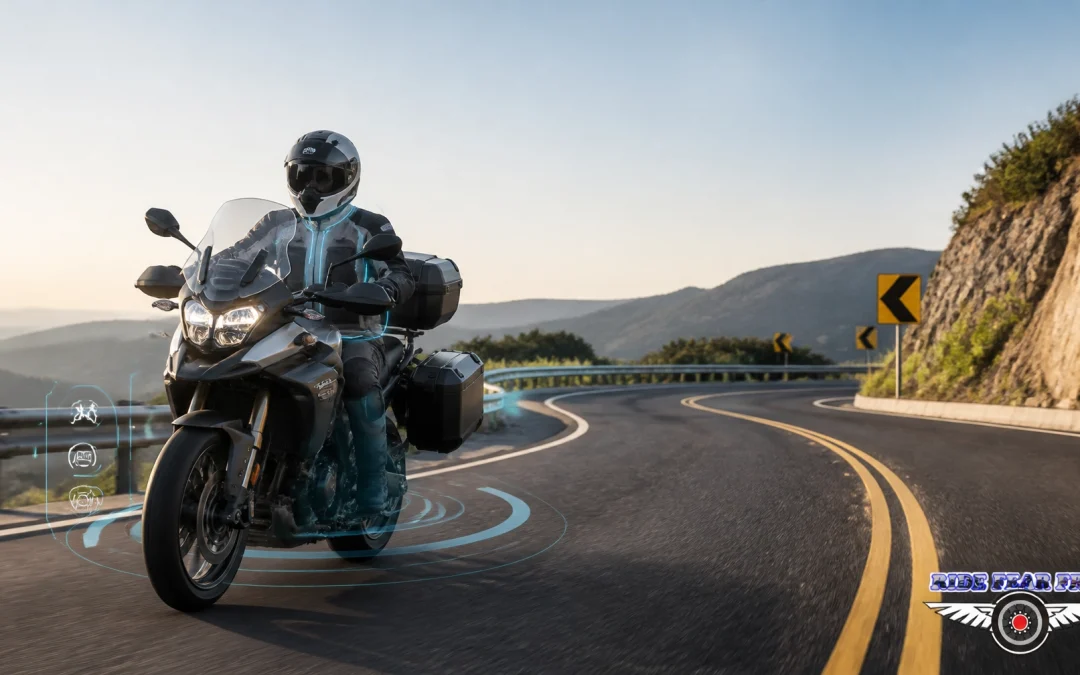
Yamaha’s official AMSAS overview describes a system designed to stabilize a motorcycle at very low speeds by controlling drive and steering forces. The development platform uses a six-axis inertial measurement unit, along with drive and steering actuators.
The system is designed to assist during the moments when a motorcycle is most unstable:
- Starting and stopping
- Walking-speed operation
- Tight turns and slow U-turns
- Low-speed balance corrections
Yamaha explains that a drive actuator assists at the front wheel during starting and stopping. At very low speeds, a steering actuator makes small corrections through the handlebars. The result is a motorcycle that can remain upright during controlled demonstrations with limited rider input.
That is promising, but it is important to describe AMSAS accurately. It remains an emerging development platform rather than a universal production feature available on every motorcycle. Its future value will depend on cost, durability, rider acceptance, service requirements, and how well it works with other safety systems.
The takeaway: Stability assistance may help reduce certain low-speed falls, but it does not teach throttle control, braking, cornering, hazard recognition, or traffic strategy. Technology can support skill. It cannot replace skill.
Honda Gold Wing Airbags: A Production Layer of Protection

The difference: AMSAS is intended to help prevent some low-speed incidents. Honda’s Gold Wing airbag is designed to help reduce injury severity after a qualifying frontal collision.
Honda describes its Motorcycle Airbag System as a production safety system that uses an airbag module, impact sensors, and an electronic control unit. When the system detects a serious frontal impact, it can deploy in front of the rider to help reduce forward movement.
This is not the same as a car airbag, and it does not protect against every crash type. Motorcycle crashes can involve sideswipes, slides, rear impacts, low-side falls, high-side crashes, and contact with road furniture. Honda’s system is intended for a specific situation, especially a severe frontal collision.
That limitation does not make it unimportant. It makes the technology easier to understand.
A production motorcycle airbag demonstrates that advanced crash protection can be engineered into a motorcycle platform. It also gives manufacturers, dealers, regulators, and researchers a useful reference point as they consider future safety systems, including wearable airbags, connected warnings, advanced braking, and stability control.
The takeaway: A built-in airbag is an additional layer, not a substitute for a certified helmet, protective jacket, gloves, pants, boots, and a properly maintained motorcycle.
PRIME-Style Bend Markings: Helping Riders Read the Road

The road matters: Even a well-trained rider can be surprised by a tightening curve, limited sight distance, poor pavement, changing weather, or an oncoming vehicle crossing the centerline.
PRIME stands for Perceptual Rider Information for Maximising Expertise and Enjoyment. The approach was developed through motorcycle safety work associated with Transport Scotland and road operators. The PRIME installation toolkit explains how special markings and signs can be placed near selected bends.
The markings are designed to influence behavior without creating a new legal rule. They can encourage riders to:
- Reduce speed earlier
- Brake more smoothly
- Choose a safer road position
- Avoid cutting across the centerline
- Look farther through the bend
- Enter the curve with more control
PRIME-style treatments have also inspired related road-marking approaches in other European locations. However, they are not a single EU-wide standard. Adoption depends on the local transportation authority, road design, evaluation results, and regional policy.
That distinction matters for agencies in the United States. A state DOT should not simply copy a road marking from another country and assume the same result. Instead, agencies can study the human-factors principles, identify motorcycle crash locations, consult riders and trainers, and evaluate treatments through a disciplined pilot program.
The takeaway: A road marking can improve a rider’s decision window, but it cannot remove the need to slow down, maintain a clear line of sight, and leave room for unexpected hazards.
The Safety Stack: Technology Plus Human Judgment
What happens when these ideas are considered together?
Manufacturers can develop stability assistance, advanced braking, airbags, lighting, and connected safety systems.
Dealers can explain those features clearly and connect new owners with training before the first long trip.
Trainers can teach riders how technology works, where it has limits, and how to respond when conditions exceed the system’s design.
DOT and state transportation agencies can identify high-risk locations, improve pavement and signage, study motorcycle-focused markings, and include motorcyclists in road design decisions.
NHTSA and NTSB can support research, education, standards, crash data improvements, helmet use, training, sober riding, and broader adoption of effective safety technologies.
Riders still make the final operating decisions. That includes choosing a safe speed, keeping a proper following distance, scanning intersections, using lights and reflective gear, maintaining tires and brakes, and refusing to ride impaired.
NHTSA’s motorcycle safety guidance emphasizes helmets, protective equipment, visibility, and sober riding. NTSB also encourages training and the use of motorcycles equipped with safety technology such as antilock braking systems.
How is that for a useful reality check? The smartest motorcycle in the world still needs a thoughtful person in the seat.
What Ride Fear Free Is Building
Ride Fear Free exists to help connect the people who influence motorcycle safety. Our mission and company overview describe a broader approach that combines education, media, training, public awareness, and industry partnerships.
Our related platforms support that mission:
- Follow motorcycle updates through Ride Fear Free News.
- Watch safety and industry programming on Ride Fear Free TV.
- Explore training and rider resources through RideFearFree.us.
- Learn about outreach opportunities through the Ride Fear Free Foundation.
- Review our motorcycle safety stakeholder framework.
- Read the proven motorcycle safety framework.
The goal is straightforward: move good ideas from research and demonstration into practical education, better communication, and safer riding behavior.
The Ride Fear Free Takeaway
Yamaha AMSAS, the Honda Gold Wing airbag, and PRIME-style bend markings represent three different directions in motorcycle safety:
- Prevent certain incidents through rider assistance.
- Reduce injury severity when a crash occurs.
- Improve the road environment before a rider reaches danger.
Together, they show why motorcycle safety must be treated as a system.
No matter who you are or where you live, the basics remain essential: train regularly, wear appropriate protective gear, stay visible, maintain your motorcycle, ride sober, and use sound judgment. If you have any doubt about a corner, a weather change, your fatigue level, or another driver’s intentions, slow down and create more time.
What motorcycle safety technology or road treatment would you like to see studied in your community? Leave a comment, subscribe to the Ride Fear Free YouTube show, and share this article with a rider, dealer, trainer, agency, or manufacturer.
Watch the Ride Fear Free YouTube show, and subscribe on YouTube.
Contact Ride Fear Free
Visit www.RideFearFree.net
AI Receptionist: +1 (970) 693-4854
Dan Kost, CEO
Connect with Dan Kost on LinkedIn
Share and Follow
- Share on LinkedIn
- Share on Facebook
- Share on X
- Follow Ride Fear Free on Instagram
- Follow Ride Fear Free on Facebook
- Follow Ride Fear Free on X
- Follow Ride Fear Free on LinkedIn
- Explore Deck Dan Worldwide resources
Tags
#Motivation #Branding #Strategy #Marketing #AdvertisingAndMarketing #digitalmarketing #Innovation #Sports #MotorcycleSafety #RiderTraining #RoadSafety #MotorcycleTechnology #SafeRiding
